pi-claude-bridge: your Claude Pro, Max or Team subscription inside pi
Posted on Sat, 24 Oct 2026 in Tools
At work the model budget is a Claude Team account. And that always raises the same question: does this session come out of the subscription, or out of a separate API key? pi-claude-bridge goes exactly there: Claude models show up in pi's /model and the conversation spends subscription quota instead of billed tokens.
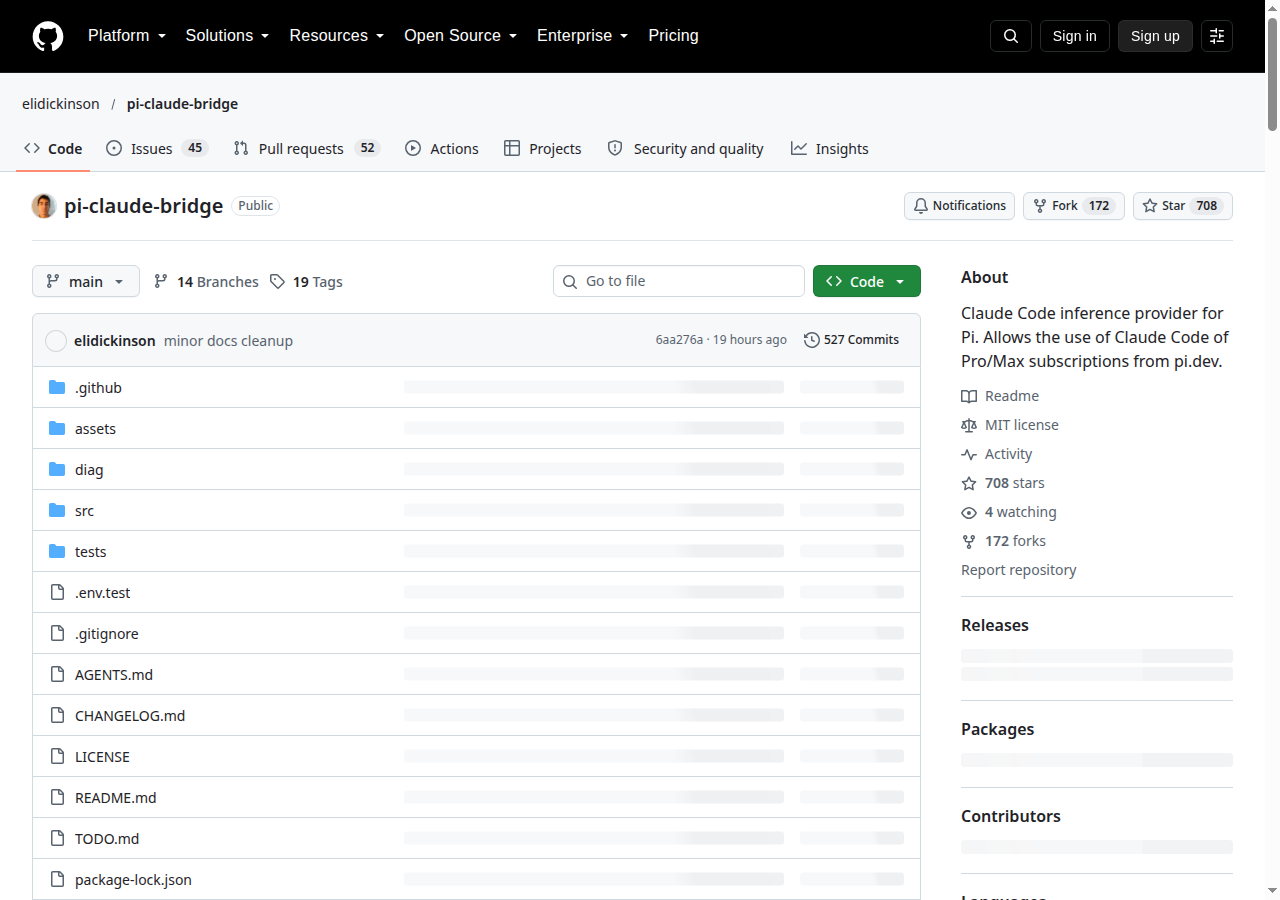
What it actually is
It's a pi extension built on the Claude Code Agent SDK. It started as a fork of Prateek Sunal's claude-agent-sdk-pi and does two things:
- Provider — Registers a
claude-bridgeprovider with the Claude models from pi-ai's catalog. Every tool call flows through pi's TUI, so you see what you'd see with any other model. AskClaudetool — Lets you delegate a question to Claude Code while running another provider. It's marked deprecated.
pi install npm:pi-claude-bridge
Requires pi 1.2.0 or newer for all models to be available.
Using it as a provider
/model claude-bridge/claude-opus-5
That's it. Behind the scenes pi translates its tools into Claude Code's format, so the workflow doesn't change: same tools, same session, same subagents. A few things do change and are worth knowing:
- Bash gets a 120-second timeout, Claude Code's default. pi's bash has no timeout of its own, so it inherits the bridge's.
- Skills are forwarded into Claude Code's system prompt.
- Mid-turn steering reaches Claude at the next tool boundary, not immediately.
- The model list is pi-ai's. When pi-ai adds a Claude model it appears in
/modelafter you update the package, without waiting for a bridge release. Dated snapshot ids (claude-opus-4-5-20251101) are hidden.
Login: the bridge has no login of its own
This is where quite a few people trip first (issue #201 in the repo). The extension does not authenticate against Anthropic on its own: it spawns the claude binary and uses whatever session Claude Code already has. pi's /login for the anthropic provider is unrelated, and using it expecting the bridge to inherit it ends with you paying Extra Usage without noticing.
So the first thing is to check which account claude is logged in with. Inside Claude Code:
/status
Account:       you@company.com
Organization:  Your Company
Login method:  Claude Team account
If it says Claude Max account, Claude Pro account or Claude Team account, the bridge uses that session. If it says an API key, it doesn't.
And just in case: turn Extra Usage off in Claude's settings. If Claude Code can't draw on your subscription for a request, the fallback is billing you the overage, and that's better found out before the invoice than after.
1M context
A million-token context isn't available the same way on every plan, and the bridge needs to know yours. It's configured in ~/.pi/agent/claude-bridge.json:
{
  "provider": {
    "plan": "max",
    "longContextExtraUsage": false
  }
}
With plan: "pro" (the default) you get 1M on Fable 5/5.1, Opus 5.5/5/4.8/4.7 and Sonnet 5.5/5. Opus 4.6 only reaches 1M on a Max plan or with Extra Usage, and Sonnet 4.6 only with Extra Usage. Watch the value's name: if your account is a company one, the README still tells you to set max, because that's what enables long context on Team Premium and Enterprise. Odd, but that's how it is. If your plan advertises 1M but Claude Code won't serve it, forceTwoHundredK pins specific models to 200K:
{
  "provider": {
    "plan": "max",
    "forceTwoHundredK": ["claude-opus-4-6"]
  }
}
The rest of the config
{
  "provider": {
    "strictMcpConfig": true,
    "autoMemoryEnabled": false,
    "pathToClaudeCodeExecutable": "/home/you/.nix-profile/bin/claude"
  },
  "askClaude": {
    "enabled": false,
    "defaultMode": "read",
    "allowFullMode": true
  }
}
strictMcpConfig is on by default and blocks MCP servers from ~/.claude.json and .mcp.json. That makes sense: if you already have MCP in pi, loading Claude Code's on top duplicates tools and burns context. Cloud MCP (Gmail, Drive via claude.ai OAuth) is always blocked.
pathToClaudeCodeExecutable is for when the SDK's bundled binaries can't run on your system. Nix is the classic case: point it at the claude from your profile.
What to know before using it
This is not just another provider, and it has traps the repo documents. The important ones:
Rebuilding a session re-sends the whole conversation. The bridge rewrites Claude Code's session from pi's history whenever the two diverge: after an abort, a /compact, tree navigation, an API error, or on returning to a session. The next request usually misses the prompt cache for everything past the system prompt. In abort-heavy sessions you feel it in the bill.
Files Claude Code edits don't survive a rebuild. The edit itself does, it stays in the history as a tool call and result. What's lost is the file snapshot after the edit. @file expansions are preserved.
System prompt changes mid-session may not reach the model. Claude Code records the first request's prompt (project context, skills, extension instructions) and reuses it on resume. That keeps the cached prefix stable, but if you edit AGENTS.md mid-session it may not take effect until a rebuild or compaction.
Exported ANTHROPIC_* variables hijack the child process. An ANTHROPIC_BASE_URL, ANTHROPIC_API_KEY or ANTHROPIC_AUTH_TOKEN in your environment redirects Claude Code to that gateway and every turn fails with its auth error. If you have one of those in your .zshrc, drop it from the pi process.
modelOverrides from models.json doesn't work here. They only apply to pi-side settings like the compaction threshold. To change contextWindow you edit src/models.ts or use forceTwoHundredK.
Details that surprised me for the better
Claude Code hooks keep working. ~/.claude/settings.json fires inside bridge turns. That can be useful or a mess: a hook injecting Claude-specific guidance duplicates what your pi extensions already do. The escape hatch is the one the README suggests:
[ -n "$PI_CODING_AGENT" ] && exit 0
pi sets PI_CODING_AGENT=true on child processes, so the hook opts itself out when it runs inside pi.
Compaction is still pi's job. The bridge routes those calls to isolated Claude Code queries, leaving the live session untouched until pi finishes rewriting the history.
Plan usage can be read from other extensions. Claude Code emits a rate_limit_event when a usage window changes, and the bridge passes it through the after_provider_response event as anthropic-ratelimit-unified-* headers, with the same names the Anthropic API uses. An extension that already reads those headers for the native anthropic provider can accept claude-bridge unchanged.
Coexistence with subagents. With @gotgenes/pi-subagents you need this in ~/.pi/agent/subagents.json:
{"promptInheritance": {"claude-bridge": "portable"}}
On billing
Anthropic announced and then un-announced a change to how Agent SDK usage gets billed. As of today this extension spends your subscription quota just like Claude Code. There is also an announced change where Max and Team plans include monthly API credits, and the repo doesn't know yet whether that will eventually reach the bridge: the consensus in the issues is "same as ever for now".
That's why it interests me at work and not at home: where Claude is already paid for, the bridge makes sense; where it isn't, none.
How I use it
On the work machine I have a Claude Team account and pi is my harness. This is what I want to set up there, and it's worth saying plainly: I haven't tested it on that machine yet. What I have verified is what I describe above — configuration, how it works inside, and the traps the repo documents. Once it's been running for a few days I'll update this post with the verdict and with whatever plan value I end up with.
The approach is what interests me: the TUI is pi's, the tools are pi's, the skills are pi's, and underneath the thing talking to Anthropic is Claude Code with my session. No loose API keys, and no choosing between the agent I like and the model that's already paid for.
The real downside, when I test it, will be abort-heavy sessions, where the bridge pays the price of rebuilding history.
At home the setup is the opposite: an OpenCode Go subscription and pi-provider-opencode-console for a live model catalog.
Resources
- pi-claude-bridge on GitHub — Code, config and known issues
- On npm —
pi install npm:pi-claude-bridge - Claude Agent SDK — The foundation it builds on
- claude-agent-sdk-pi — The project it came from
- The OpenCode bridge — The other provider extension I use