aa-opencode: OpenCode models with benchmarks and price in one table
Posted on Wed, 21 Oct 2026 in Tools
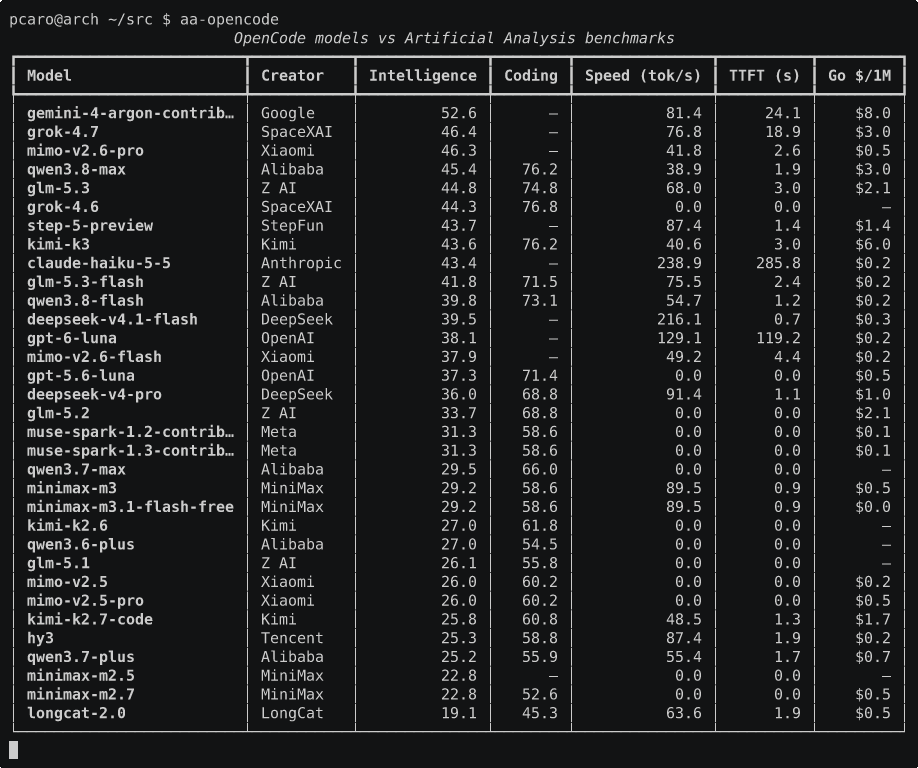
I use OpenCode as one of the model providers in pi, and there's the problem: the list of available models is long and says nothing. You get names, sure. What you don't get is how well each one reasons, how fast it answers, or what a million tokens costs you. Picking by eye is a coin toss.
Artificial Analysis publishes exactly that: independent intelligence, coding, and math indices, plus output speed, time to first token, and price. But it has its own catalog and its own names, so crossing it by hand against OpenCode's models is a chunk of work every time you want to check.
So I wrote aa-opencode: it grabs the OpenCode model list, crosses it with the Artificial Analysis API, and prints a table. Nothing else. It's about 430 lines of Python with httpx and rich.
Installation
uv tool install git+https://github.com/pcaro/aa-opencode
It needs an Artificial Analysis API key, which is free: create an account, generate the key, and put it in the environment.
export ARTIFICIAL_ANALYSIS_API_KEY="your-key"
It also reads AA_API_KEY, and if you want to pass it ad hoc there's --api-key.
Usage
# Default table, sorted by intelligence
aa-opencode

# Other sort keys
aa-opencode --sort price
aa-opencode --sort speed
aa-opencode --sort coding

# JSON to chain into something else
aa-opencode --format json
By default it pulls the Go catalog. For the Zen catalog:
aa-opencode --catalog zen
What comes out
The Go catalog has 33 models with data in Artificial Analysis. The first thing that jumps out is that the smartest model in the catalog isn't the one I'd use for coding every day. gemini-4-argon-contributor leads with a 52.6 index and costs $8.0 per million. mimo-v2.6-pro scores 46.3 and costs $0.5. Sixteen times less for 11% less index.
On coding it flips. mimo-v2.5 scores 60.2 on the coding index at $0.2 per million, and muse-spark-1.2-contributor scores 58.6 at $0.1. Those are models I would never have considered opening without seeing those numbers side by side.
Speed: claude-haiku-5-5 runs at 238.9 tok/s and deepseek-v4.1-flash at 216.1. But look at the first one's TTFT: 285.8 seconds. That's not time to first token, it's an artifact of the test (queues, rate limits, whatever happened that day). TTFT from the API has to be read with tongs.
And price. OpenCode's price doesn't come from Artificial Analysis: it comes from models.dev, which is the source OpenCode uses for its catalog. Comparing the two, there are models where OpenCode charges you noticeably less than the public reference: mimo-v2.5 68% less, longcat-2.0 60% less, deepseek-v4.1-flash 50% less.
Zen is a different picture. There the top models run $20 per million (claude-fable-5-1, gpt-6-astra), and the quality/price ranking fills up with models that don't even show in Go.
Four Go models have no Artificial Analysis data: omen-alpha, hy4-preview, longcat-2.5-preview-free, and beam-free. They're previews and free models, so that's expected. In JSON they show up with matched: false, and in the human table you list them with --show-unmatched.
How it matches models
OpenCode IDs and Artificial Analysis slugs almost never match, so the matcher tries three things in order:
Exact slug. gpt-5.4 against gpt-5.4. Normalizing first: lowercase, dots to dashes, and everything non-alphanumeric stripped.
Substring. If one contains the other, it keeps the shortest slug, which is the most specific one. That's where things like gemini-4-argon-contributor → gemini-4-argon land.
Token set. For reordered names, like haiku-4-5 against 4-5-haiku.
It's pure heuristics, there's no hand-written equivalence table. It works well enough, but a badly matched model gives you believable, wrong numbers, which is the worst kind of error. When OpenCode adds new models, it's worth eyeballing the row before trusting it.
What it doesn't do
- It doesn't tell you which model suits you. It just puts the numbers together and sorts them.
- It doesn't check availability: if a model is down, it won't notice.
- It keeps no history. Every run is a snapshot.
- There's no manual equivalence table, so odd matches are possible.
Using the free Artificial Analysis API requires attribution, so: benchmarks come from Artificial Analysis and OpenCode pricing from models.dev.
Original source: github.com/pcaro/aa-opencode